One hundred years ago this past week, the three owners of an advertising business in New York incorporated their company at the state registry in Albany, NY. Aptly named for the purpose of this article, Century Advertising Service Inc came into being. You won’t have heard of Century Advertising Service, though. Nor, I am willing to bet, will you have heard of Bronx Paper Stock Company, S.R. Kerner Dress Company or any of the 39 other companies incorporated in the state capital on March 6th of 1917. These businesses, like many before them and many since, have closed their doors to the world long ago. Some will have come to a dignified end – subsumed into another business or closed on the retirement of their owners – but most will have met a more unpleasant end: outpaced by competitors, short of working capital or starved of sales by disappearing marketS. Many of these will have joined the long list of companies forced to declare themselves ‘insolvent’.
Failure: a good thing, a bad thing
It’s a natural inclination to view business failure as a bad thing… business owners lose their investment, creditors lose money, and employees and the communities that they live in lose valuable jobs. The downside of business failure is not open to debate. But in a market economy corporate failure does serves a valuable purpose: it redistributes (often rapidly – see box) financial and human capital away from where it is not needed or not effective.

Portraying business failure in such utilitarian terms may apear callous; the loss of investment, receivable or employment can all cause hardship to an individual, business or community. But at the macro level, the economy (and ultimately society as a whole) benefit from the quick and efficient movement of workers, capital and other resources away from uncompetitive businesses and out of twilight markets.
Compare, by way of contrast, the excruciating inefficiencies of Soviet-era Eastern bloc economies where workers toiled in centrally-directed industries with poor productivity levels and widespread technology obsolescence. The economies enjoyed the significant increases to efficiency and labor (and as a result productivity) in the late 1990s and early 2000s as they made the transaction to market-driven economies (See 2008 World Bank report).
Growth and innovation are closely tied to how efficiently labor and capital are distributed and re-distributed.
So what?!
My point in all of this is the lesson it offers to businesses trying to effectively marshal their scarce resources to grow and develop.
The overwhelming majority of corporate failures are of small companies (because the overwhelming majority of companies are small). These companies, or rather their owners, rarely have the resources to sustain a failing business. But large companies offer a much more fertile(!) environment for failing business ventures to stagger onwards continuing to consume the company’s scarce capital, human resource and management time well beyond the point in time where they should have been closed, sold, restructured or simply culled.
Sustaining a venture that is faltering is a good thing if the problem is simply short-term cash flow; a standalone venture might have failed, but as part of a larger business it will hopefully go on to prosper. However, if the venture is fundamentally flawed there is a risk that it will carry on, existing as something of a ‘zombie businesses’, to the detriment of the organization as a whole as well as the people working in it. How can this happen? Well, the underlying reasons are many but here are a few that I’ve witnessed over the years:
- No clear parameters have been set for what success (and therefore failure) looks like
- Leaders do not have the ‘bandwidth’ to securitize the success or otherwise of the relevant venture or initiative and focus their time on other areas (often more urgent, by typically of less impact)
- The organization lacks – to a greater or lesser degree – a drive to ensure that its human and financial capital is deployed in the most effective way possible and redeployed in the most efficient way possible
- The people that work in the venture or have helped to ‘sponsor’ it succumb to optimism bias, confident that the venture is fundamentally sound and that a turn around in fortunes will inevitably turnaround at some point
- The organization’s culture views failure negatively, discouraging leadership and employees from admitting failure, let alone learning from it.
Thinking differently about failure
Mastering the art of failure requires a company – particularly its senior leadership – to think differently about risk and failure. To replicate the effectiveness and efficiency with which, across the market as a whole, corporate failure results in the redistribution of resources requires a business to:
- accept that risk – and therefore failure – is a natural part of corporate life
- recognize that the organization’s resources are both valuable and scarce and that it is unacceptable for them to be poorly applied, and
- move decisively and with pace to end faltering corporate ventures and initiatives (or otherwise intervene to get them back on track).
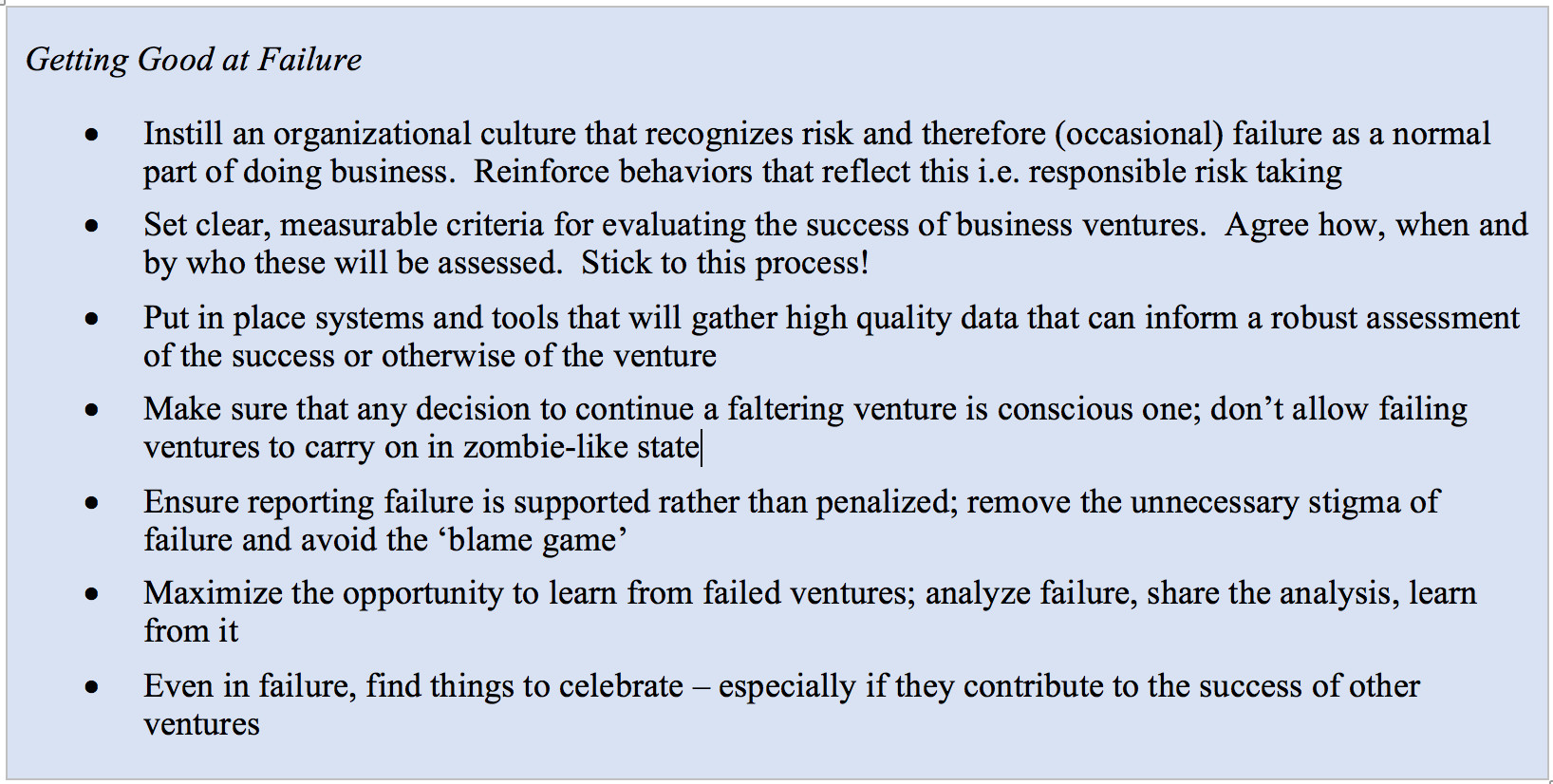
There are a number of practical steps that an organization can take to get better at failure (see box below), but mindset is key. If leadership can successfully instill this across the business, the company will most likely prosper. If they cannot it will likely fail… ending up, like Century Advertising Service, little more than a footnote to history!

 Concept and Perspective