Running a business is about getting things done.
Yes, I know that is a statement of the blindingly obvious, but for leaders trying to effect change and drive growth in pursuit of longer-term objectives, it is often difficult. They face a persistent challenge: reconciling the seemingly limitless array of things that they could do, against what limited resources (i.e. time, money, people) will actually allow them to do. And it’s difficult enough to narrow the corporate ‘to do’ list to those things that are important to grow and develop the business, let alone make those priorities understood right across the organization and effectively implemented.
Loosing sight of longer-term objectives can manifest itself in various ways and be fatal to any business. Companies may succumb to ‘short-termism’, their focus perpetually directed at day-to-day operational needs over longer term priorities. These businesses are permanently in a reactive, ‘firefighting’ mode. Others succumb to complacency, convinced that change isn’t really needed or that growth can be deferred. These companies are at risk of being by left behind by changes in their market(s) or overrun by other companies that can outcompete them.
Focusing on key objectives, making sure that those objectives are understood by employees, and then relentless pursuing them has therefore become a crucial capability for organizational success.
A goal without a plan is just a wish
Business planning is, or should be, the go-to tool for identifying, tracking and implementing an organization’s key objectives during a given business cycle (typically 12 months but some times a shorter or longer period). Planning bridges the company’s long-term goals (i.e. where it wants to be in 10 or 15 years) and its day-to-day operational planning around winning, executing and getting paid for work. Although preparing a business plan is an activity often associated with a new venture, all businesses should have a plan that drives growth and development, whether in a written document or hard wired into their management processes.

Business planning is undergoing something of a revolution, driven by three things. Firstly, there is a renewed interest in so called management by objectives, which Peter Drucker first popularized in the 1950s. This movement, embodied in the increased use of ‘OKR’ (short for objectives and key results), particularly amongst large corporations – is in turn driven by a recognition that a business’s resources, especially its people, best support growth and development when directed at a limited set of clear, well communicated and focused goals that are aligned with long term objectives.
Secondly, short term shocks in the business environment driven by things like COVID-19, severe weather events or a sudden decreases/increases in commodity prices have shown that processes which help organizations to respond quickly and (re)deploy their resources with agility are invaluable. Lastly, the development of cloud-based planning tools has simplified how planning is done, and made it easier for companies to share and update objectives across organizations, irrespective of their size, geographic footprint, (lack of) IT integration, etc. Businesses that use planning have be shown time and again to perform better than those that do not.
Shifting to agile, focused, technology-enabled business planning
Traditionally, the development of a business plan involves preparing a detailed document setting out ‘what, where, for whom and why’ of the company’s business along with market data and a financial plan. By way of illustration, the S.C.O.R.E. template for established businesses spans eleven sections and runs to 35 pages, and would take most companies a number of weeks to compile, review and finalize. There are situations where writing such a detailed plan is valuable (perhaps essential e.g. when seeking funding), but most organizations are better to apply their preciously scarce management time to identify and deliver key objectives. The traditional approach has a number of shortcomings:
- the production of the plan itself becomes the main objective of the exercise making the plan a static document rather than a tool drives getting things done (and implementation is everything)
- it is easy to produce a long ‘laundry list’ of objectives that fails to focus scarce resource on what is important
- producing, or even updating, a traditional format detailed plan simply takes too long. When reacting to rapid shifts and a dynamic market conditions, businesses need to focus on what is important and start getting things done today
- the business plan is often shared only with senior management plus a small cohort of other stakeholders, missing the broader employee base and along with it an vital opportunity to engage them in delivering the organization’s key objectives
- it’s impractical to scale-up detailed, document-based business planning for use in large, complex and diverse organizations.
There has been (and needs to be) a shift away from the traditional approach to business planning. The alternative, what I call agile business planning, has four key elements…
- planning focusses scarce resources on what matters. This should be a small number of key objectives that are clear, measurable and align with both the organization’s strategy and its long term vision
- planning drives implementation (remembering that implementation is everything!). The business’s key objectives form part of a planning hierarchy and are accomplished via a broader subset of actions/initiatives which, in turn, are achieved via specific tasks assigned across the organization. People are held accountable for delivering tasks assigned to them
- planning makes the plan a living tool rather than a static document. Progress is tracked, objectives and actions are updated as completed, or is refined as the business environment/resource demands change
- planning employs technology to optimize reach, accountability and agility. Several low-cost, cloud-based planning tools (imagine a project management tool for business management) have emerged in recent years. I use, and love, Business Sorter a comprehensive framework for business planning, that helps to create the plan (including suggesting content), share, drive implementation and track progress.
The benefits of agile business planning are a greatly enhanced chance of delivering the company’s key objectives, greater transparency (and therefore alignment) across the organization’s employees as well better visibility for management of progress against the plan.
The advantage of this approach are particularly evident for a company’s workforce. Planning platform provider perdoo reported a study of a company with over 1000 employees and which found that by automating the process of setting goals, the ROI of goal management amounted to a saving of $520K annually in efficiency gains. Similarly, OKR expert Ken Lemorte reported in research on Sears Holding Company that the use of OKRs across 20,000 sales associates over a period of the 18 months demonstrated that “even minimal use of OKRs led to higher levels of performance, including an 8.5% increase in hourly sales at a call center and an 11.5% increase in the chance of high performance across their corporate associate population.”
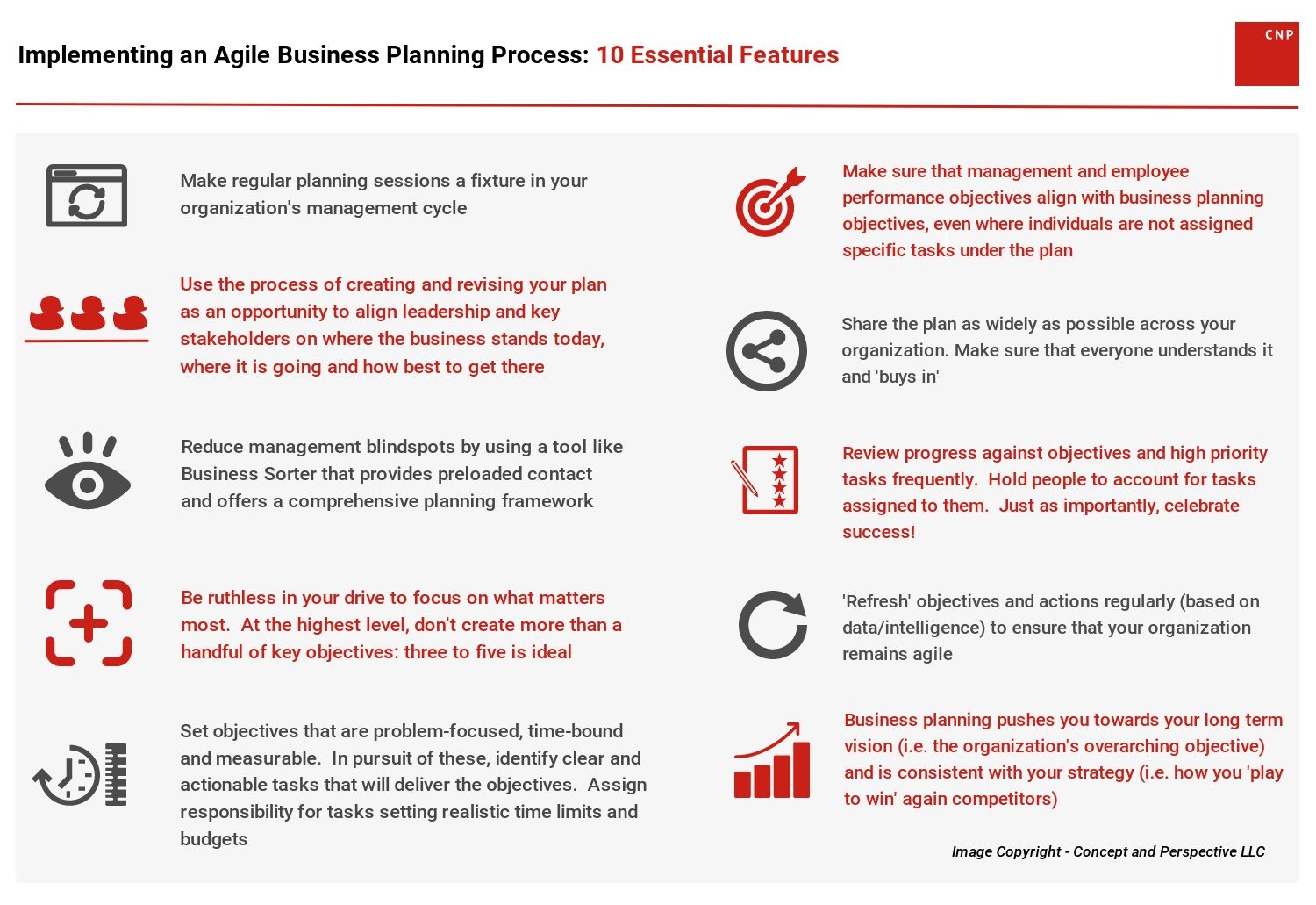
Agile planning can be used across an entire organization or be applied to individual geographies, business/product lines, etc. Irrespective of where it is applied, there are some essential features need to be in place for the process to drive growth and long term development (See below).
Do you need help to focus your organization on what’s really important?
CNP provides pragmatic advice and practical support with business planning, and can help you to implement an agile planning process across your organization, including choosing and rolling-out a cloud-based planning tool such as Business Sorter.
We can facilitate planning sessions (or train your facilitators to do the same), and also help you to put in place processes that sustain agile planning and drive long term growth and development.

 Concept and Perspective