
The principal concern of most buyers when it comes to intellectual property (IP) is compliance: identifying the target’s IP and ensuring that it is owned/registered to the business being acquired, control of the IP, potential liability or infringement claims, and encumbrances. There is typically less consideration of how the target’s IP can generate additional cash flow under new ownership or the opportunities to create or bring fresh IP to bear.
IP is an asset, often a highly valuable one. It can drive sales and dollars to the bottom line. In any market, there is also the opportunity to leverage new IP – such as employing a creative new trademark – to increase revenue and profit.
But why does this get overlooked? Are sellers leaving money on the table? Do buyers risk undervaluing IP-rich businesses? To help me figure this out, I turned to Houston-based IP guru Rich Ruble, formerly with Vinson & Elkins, LLP, and current President of The Ruble Law Firm, P.C.
CHRIS: To get us started, what role should IP play in the context of an M&A transaction?
RICH: Hey Chris, happy to discuss and share some perspectives. Well, the IP side of an M&A transaction is often an afterthought… for both parties. At least in middle market transactions, Buyers are typically in the driving seat of the due diligence process. As such, there is an emphasis on checking the boxes, i.e., confirming that the seller owns the IP they claim to own by checking registration records, assignment records, etc., and checking to see if there are any pending (or threatened) disputes relating to the IP in an effort to mitigate risk. The seller is typically just “along for the ride,” complying with the requests of buyer’s counsel. With this approach, both parties are at serious risk of leaving value on the table.
CHRIS: What should they do differently?
RICH: The quick answer? Both parties should make an IP value assessment BEFORE the deal process begins.
CHRIS: How?
RICH: Let’s talk buy-side first. Deals happen because a buyer is in need of “something,” something they don’t have already such as technology, capability, geographic footprint. Buyers typically identify potential M&A targets that can give them that thing and rank them primarily in light of various financial metrics. I believe that not considering IP when evaluating potential targets risks leaving value on the table and/or results in additional risk of IP-related litigation for the Buyer. A meaningful IP assessment will (almost always) allow you to capture additional value and lessen IP risk.
CHRIS: What should the buyer do then?
RICH: In order to maximize the value (and minimize the risk) associated with an M&A transaction, the buyer’s review of potential M&A targets should include an assessment of each target’s IP and whether they have taken steps to protect it. This can usually be done independently using publicly available sources…without tipping off potential acquisition targets. Information obtained during the IP assessment can be used to “weed out” potential targets and/or adjust the purchase price of the target company. There’s another advantage though…
CHRIS: What’s that?
RICH: You can also get a feel for how a target company handles their business by looking at how they handle their IP. For example, if a company doesn’t bother to file a trademark application for their flagship trademark, you know there are other aspects of their IP and, probably their business overall, that they are neglecting. Not only that, unregistered trademarks (often referred to as common law trademarks) are ripe for litigation. Some buyers may wish to avoid targets that neglect their IP as there is a higher risk potential associated with the transaction.
CHRIS: That sounds like great advice for a cautious, long-term-focused buyer. What about more aggressive buyers…like companies in the business of acquiring other companies hoping to eventually sell them on, pursuing accelerated growth, or taking them public?
RICH: Great question. Aggressive buyers may want to acquire a target that has neglected their high-value IP, and some look to do that at a bargain price. A key consideration there will be determining that ownership of the target’s IP can be perfected (i.e. formally protecting the owners’ rights) quickly after the acquisition. For example, let’s say the target has high-value trademarks but management have not bothered to perfect their rights using registrations. Trademark searches can be conducted by the buyer to see if other parties have developed competing rights. If they have not, the buyer can acquire the target and then make filings as soon as possible to perfect the buyer’s rights in the newly acquired trademarks… thus resulting in what might be a significantly increased value of the acquired company’s IP (and, of course, protecting it in the doing so).
CHRIS: Got it… What about the Seller?
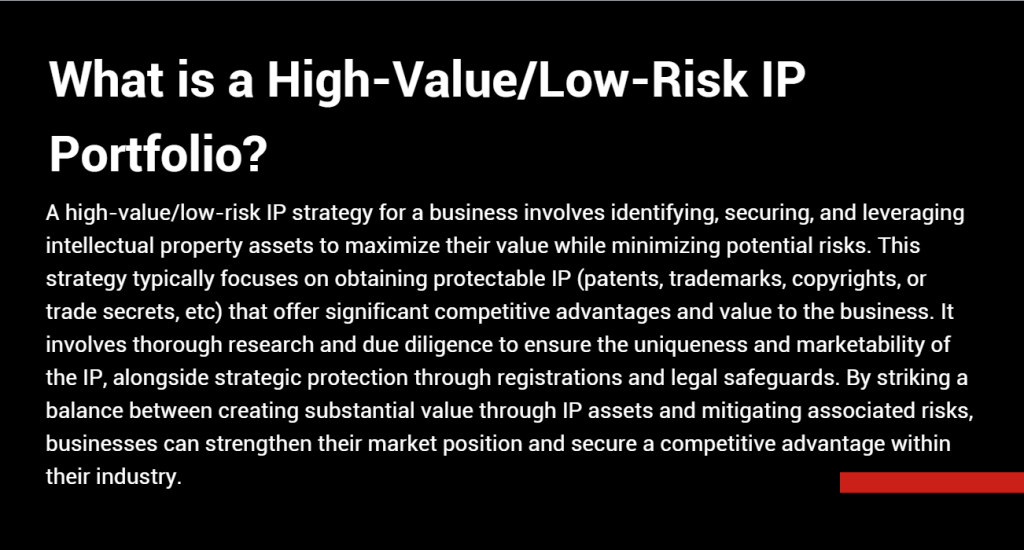
RICH: The Seller needs to conduct an IP value assessment BEFORE the deal is even on their radar. They need to assess what IP they have and re-direct their marketing and R&D resources to their high-value/low-risk IP. Legal filings, e.g., trademarks, copyrights, patents, etc., should be made as soon as possible to formalize these rights in their primary market. Having a high-value/low-risk IP portfolio (with appropriate legal protections) makes the seller attractive not only to potential buyers but will minimize their risk of IP-related litigation regardless of whether a deal happens.
CHRIS: How does having a high-value IP portfolio help the Seller in an M&A transaction?
RICH: In the M&A realm, sellers often complain that the initial price offered by a buyer is too low. Having a high-value/low-risk IP portfolio gives the seller leverage when countering a low initial offer with objective evidence of added value. Properly protected IP is a tangible, legally enforceable right. The seller need only point to the trademarks, copyrights, and/or patents in question and point out how the buyer can use them to enhance their value post-M&A. Savvy sellers will also want to (diplomatically) point out how their IP would be valuable to other large players in the relevant market.
CHRIS: Let me try to summarize that and pull together some key takeaways:
In M&A, the focus on IP often revolves around compliance, overshadowing its potential as a value-driving asset. However, an enlightened approach to IP during M&A holds significant potential for both buyers and sellers. Buyers should conduct an IP value assessment before initiating the M&A process to identify additional value and reduce IP-related risks. They should also consider a commissioning independent IP Review. Lastly, it is critical that they understand the Target’s Business through an IP and be mindful that how a company handles its IP provides insights into its overall business operations and potential risks associated with it.
For sellers, we explored the benefits of conducting an IP value assessment before the deal is on the radar to identify and redirect resources to IP. Building a high-value, low-risk IP portfolio involves strategic protection of patents, trademarks, copyrights, or trade secrets, maximizing the seller’s attractiveness to potential buyers, and minimizing IP-related litigation risks. Lastly, sellers with a well-protected IP portfolio should be sure to leverage this in deal negotiations, especially where a deal does not appear to fully take account of the value of the target’s IP.
Ultimately, considering IP as a strategic asset in M&A transactions is important for both buyers and sellers, presenting an opportunity to not only mitigate risks but also unlock additional value within the deal-making process.
This is the first installment of a multi-part article that looks at the key IP considerations in corporate development.

Do you have questions about intellectual property? Reach out to Rich Rubble: at the Ruble Law Firm, P: (281) 458-3343
LinkedIn: Connect Here
Email: rruble@rublelaw.com
Website: rublelaw.com

 Concept and Perspective