
Take any time to look through online business-for-sale listings and you quickly find 10s of 1000s of businesses listed for sale. What those sites don’t say is that a large proportion of those businesses go unsold. The owners of the businesses are forced to shutter their business or just self-off the assets at pennies on the dollar.
But why?…
Over the years the CNP team has helped clients evaluate hundreds of businesses that are up for sale. In our view, the five key reasons that small business owners are not able to sell are:
- There is a lack of detailed, reliable financial information about the business
- The business is poorly marketed by the seller or his broker/M&A advisor
- Sellers have unrealistic expectations about price or deal structure (often both)
- Ego gets in the way of getting a deal done
- At the end of the day, many of these businesses are a just a poor investment proposition
Show Me the Money (or at least show me your books)
The number one priority for a buyer after it confirms that the business fits its basic acquisition criteria, is to evaluate the target’s past financial performance/prospects. A buyer’s primary focus is (or at least should be!) to make a thorough assessment of the potential future cash flows of the business. However, to do this they need high-quality financial information; a couple of years of sloppily prepared P&Ls won’t suffice.
The lack of quality financial information has a chilling effect on the prospects of selling the business at all and tends to push the buyers’ offer down. Sellers, because of concerns over cost or confidentiality, are often reticent to prepare and/or provide quality financials, but failing to do so is contrary to their interests in selling their company and attaining a fair price.
No established business should be brought to market without having high-quality financial information on hand. The starting point is at least four full years’ historic financial statements as well as monthly financials for the trailing 12-month period. These should be prepared on an accrual basis and presented in Excel format so that an acquiror can quickly and easily undertake analysis and financial modelling. The profit and loss report should identify reasonable adjustments/normalizations to revenue and costs. The balance sheet should flag any non-operating assets or assets that would be excluded from the sale.
Also readily available should be a breakdown of key customers, key suppliers, and employees, as well as aged accounts payable and accounts receivable (these can be anonymized). Depending on the type of business, sellers should be ready and willing to provide: a fixed asset register, an inventory list, and summary of work-in-process (WIP), etc. Lastly, information that speaks to the outlook for the business should be provided. This will depend on the nature of the business but could include revenue run-rates, backlog under contract, weighted prospects, customer inquiry data, etc.
Marketing: Lost in the Crowd
In the landscape of small business sales, a prevailing issue hindering successful transactions is the tired and outdated marketing approaches. Unlike the dynamic and engaging strategies seen elsewhere, the marketing tactics for small businesses have stagnated, adhering to archaic methods that merely involve mass listings and generic descriptions. These businesses are commonly bundled together, lost in a sea of counterparts, and presented with lackluster sales collateral, typically restricted to basic website listings, simple flyers, and a cursory Confidential Information Memorandum (CIM) or tear sheet.
While industries like commercial real estate employ creative and personalized approaches to attract buyers, the small business market remains largely shackled to a formulaic process that fails to showcase the unique value and potential of each business, thereby diminishing its appeal and reducing the likelihood of a successful sale.
Unreasonable Expectations
Another key barrier to small business sales is the seller’s expectation of price and the structure of the deal that they are willing to accept.
Many times, sellers have an overinflated view of the value of their business. Often, this is because of the significant sweat and emotional investment they have made in their business. Expectations can also be overinflated when a seller speaks with friends or acquaintances who have sold a business for a high ‘multiple’; but almost always the two businesses are not comparable. Ideally, the seller’s broker or advisor should manage those expectations, but they don’t always do a great job of this, or sellers are just not willing to believe the advice.
Also, sellers are often reluctant to consider alternative structures that might unlock a deal or achieve a higher overall sale price. For example, in the current climate (fall 2023) sellers who are unwilling to consider a deal structure that includes an element of seller finance are likely to significantly narrow the pool of potential buyers. Sellers are well advised to see the bigger picture: not just purchase price but their ability to take out excess working capital, the value of post-close employment/consulting arrangements, ongoing benefits, etc
No Deal is Ever Done Without an Element of Compromise (on both sides)
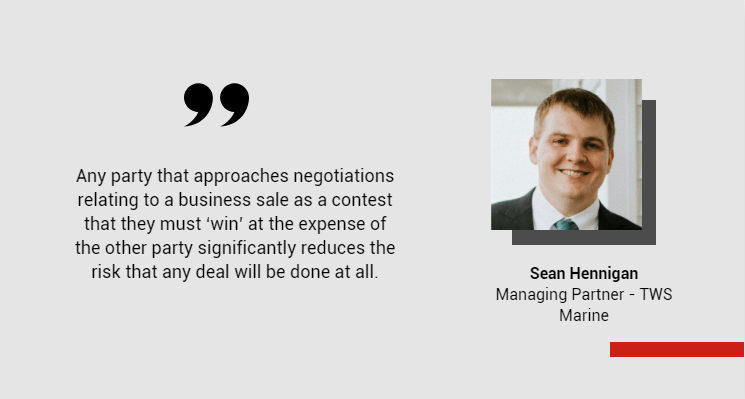
Too often, a buyer and seller become focused on “winning” the negotiation in an M&A transaction. In doing so, they both risk “losing” the deal. Sophisticated buyers and sellers recognize that negotiating the structure of any deal is largely an exercise in risk allocation, and is not necessarily a zero-sum game. By doing so they increase the likelihood of getting their deal across the line.
When a buyer has specific concerns, like retaining a key customer post-close, the deal structure might see part of the payment being contingent on this outcome. This contingent payment could be structured as an earnout or there could be a retention that pays out over time.
A buyer’s proposal to include an earn-out or a retention shouldn’t necessarily be viewed by the seller as a concession; the starting position should be to assume that the buyer’s concerns about risk are valid and that dismissing them decreases rather than increases the chance of getting a deal. When properly implemented, an earn-out can improve the seller’s tax efficiency and increase their net proceeds from the transaction.
It Doesn’t Matter How Much Lipstick You Put on a Pig, it’s still a Pig!
As Forbes contributor Richard Parker pithily put it “the majority of businesses listed for sale are garbage” (see his article here). Often, even the most superficial assessment of a ‘target’ business will reveal issues that make it an unattractive investment: shrinking markets, unstable cashflow, customer concentration, over-reliance on the seller’s know-how/skill/relationships, etc.
“The Majority of Businesses Listed for Sale are Garbage”
– Richard Parker
Not all businesses are bad, sometimes the seller has just brought it to market too early. If a seller wants to avoid scaring off buyers, key risks – such as management transition – should be addressed before the for-sale sign is put up. Equally, a buyer will want to see that the target has a sustained record of business performance and, ideally, growth. A seller should also consider external factors such as whether headwinds in the M&A market make it favorable for them to sell now, or to wait.
Summary
To summarize, the challenge of selling a small business often stems from various critical factors, including the overall appeal of the business as an investment, the quality and accessibility of financial information, the effectiveness of marketing strategies, and the alignment between seller expectations and market realities. To enhance the likelihood of a successful sale, sellers must address these obstacles by focusing on improving their business’s investment proposition, ensuring the availability of comprehensive financial records, adopting innovative and personalized marketing approaches, and realistically aligning their price and deal expectations with the current market landscape. Overcoming these challenges can significantly increase the chances of selling a small business and securing a favorable deal that benefits both the seller and the buyer.
Thank you to Sean Hennigan at TWS Marine for his input to this article.


